


Modern simulation of maritime vehicles has evolved far beyond simple buoyancy and movement. Today’s systems aim to replicate the complex physical interactions between water, hull, propulsion, and environment with a level of fidelity grounded in real-world research and naval engineering.
At the core of these advancements lies hydrodynamics—the study of how water flows around objects and how those forces influence motion. For vessels, this includes resistance, lift, wake formation, propulsion efficiency, and maneuverability. These effects are not only nonlinear but highly sensitive to speed, hull geometry, and environmental conditions.
Real Hydrodynamics, Not Just Approximation
Accurate vessel simulation depends on modeling hydrodynamic forces and moments that act on the hull during motion. These forces vary dynamically as a vessel turns, accelerates, or encounters waves. Modern approaches use computational methods derived from fluid dynamics—often solving variations of the Reynolds-averaged Navier–Stokes (RANS) equations—to capture these effects in detail. (Sage Journals)
Key phenomena that must be represented include:
- Sinkage and trim (vertical displacement and pitch under motion)
- Wave interaction and wake formation
- Pressure distribution along the hull
- Boundary layer and viscous effects
Even small inaccuracies in these areas can lead to large deviations in predicted behavior, which is why high-fidelity simulation models incorporate these factors explicitly.
Six Degrees of Freedom (6DOF)
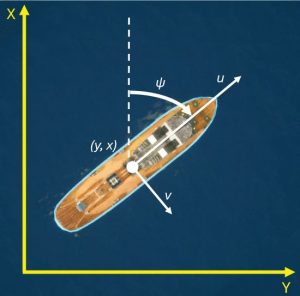
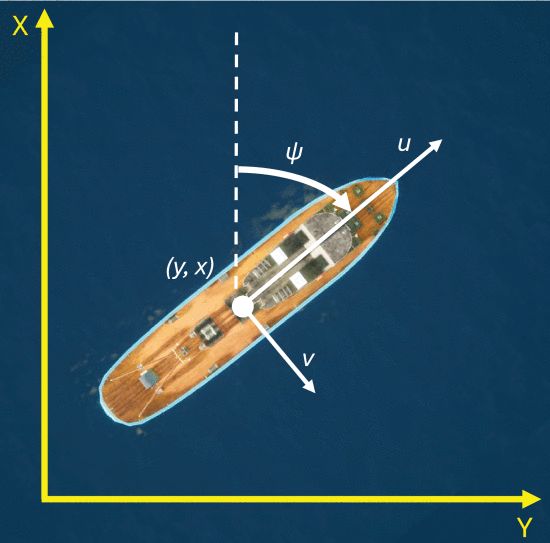
A realistic vessel does not simply move forward—it exists as a rigid body with six degrees of freedom:
- Surge (forward/backward)
- Sway (sideways)
- Heave (vertical)
- Roll (tilt side-to-side)
- Pitch (tilt forward/backward)
- Yaw (rotation left/right)
Modern simulation models treat vessels as full 6DOF systems, enabling accurate reproduction of real-world maneuvers, including turning circles, drift angles, and stability under dynamic conditions. (ScienceDirect)
Built on Proven Research Models
Rather than relying on arbitrary approximations, high-quality vessel simulation draws from validated experimental and theoretical models developed over decades.
One of the most widely referenced is the Mariner-class vessel model, which has been extensively studied through controlled experiments to derive hydrodynamic coefficients for maneuvering prediction. These coefficients allow simulations to replicate real-world steering behavior with remarkable accuracy. (Sage Journals)
Such benchmark models form the backbone of many modern systems, ensuring that simulated vessels behave consistently with physical test data and full-scale trials.
Waves, Resistance, and Real-World Conditions
A vessel rarely operates in calm water. Realistic simulation must account for:
- Wave-induced motion (heave and pitch)
- Added resistance in waves
- Propeller–wake interaction
- Environmental factors such as wind and currents
Advanced numerical methods can simulate these interactions, capturing how waves alter performance and stability. Studies show that wave conditions significantly impact resistance and motion, making them essential for accurate prediction of vessel behavior. (MDPI)
Multiphysics and Coupled Systems
Modern watercraft are increasingly complex systems. Simulation frameworks now combine multiple domains, including:
- Hydrodynamics (water interaction)
- Propulsion systems (thrusters, propellers, jets)
- Structural or suspension dynamics
- Control systems and autonomy
These multiphysics models allow simulation of advanced vessels, such as modular or articulated designs, where fluid interaction and mechanical systems influence each other in real time. (Sage Journals)
Why It Matters
Accurate simulation of boats, ships, and watercraft is no longer just about visuals—it’s about predictive capability.
High-fidelity models enable:
- Realistic training and testing environments
- Development of autonomous navigation systems
- Optimization of vessel performance and efficiency
- Safer and more reliable control systems
By grounding simulation in established hydrodynamic theory and validated research models, modern systems bridge the gap between virtual environments and real-world maritime behavior.