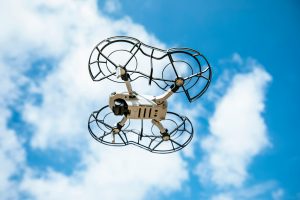


One of the greatest challenges in drone operations is maintaining stability and accuracy under unpredictable environmental conditions—particularly strong winds, turbulence, and sudden gusts. Traditional control systems are limited in how quickly they can adapt, but AI‑driven adaptive flight control is changing that. With simulation platforms like CoSys‑AirSim, these systems can be developed and tested safely before taking flight.
1. The Problem: Uncertainty in the Skies
Even the most advanced drones can struggle with:
- Sudden crosswinds during urban flights.
- Turbulence near buildings, cliffs, or moving vehicles.
- Variable conditions in long‑range or BVLOS operations.
Conventional PID controllers perform well under known conditions but often fail to adapt quickly when the environment shifts unexpectedly.
2. AI‑Driven Adaptive Control
Recent advances from research institutions, like MIT’s AI‑enabled control system, show that machine learning can:
- Predict wind patterns in real time using onboard sensor data.
- Adapt control responses dynamically instead of relying on fixed models.
- Reduce trajectory error by 50% compared to traditional control loops.
This makes drones safer, more efficient, and more reliable in real‑world scenarios.
3. Role of Simulation in Development
Testing AI‑based flight controllers directly in the field is risky and costly. CoSys‑AirSim provides a safer alternative by:
- Simulating diverse wind and turbulence patterns.
- Allowing repeatable test scenarios for benchmarking algorithms.
- Training reinforcement learning (RL) agents on thousands of hours of flight data in a controlled environment.
Researchers can push AI pilots to their limits without risking hardware.
4. Practical Applications
Adaptive control has wide‑ranging benefits:
- Urban air mobility: Safer drone taxis and delivery vehicles.
- Defense & security: Reliable operations in contested or unpredictable environments.
- Agriculture: Consistent surveying despite uneven wind fields.
- Emergency response: Greater stability during disaster relief missions.
5. Looking Ahead
As AI continues to reshape drone autonomy, regulators may soon require resilience testing under adverse weather conditions. Simulation platforms like CoSys‑AirSim will be critical for proving safety and compliance before real‑world deployment.
Final Thoughts
Adaptive flight control powered by AI represents a major leap forward for UAV resilience. By combining intelligent algorithms with robust simulation environments, the drone industry is taking a decisive step toward safe, reliable operations—no matter how the wind blows.
Image Credit: Markus Spitske